Water
Water at BUT
Water is a resource whose availability and quality cannot be taken for granted.
At BUT, as a large institution with dozens of buildings, we monitor how we use water and seek ways to use it more efficiently.
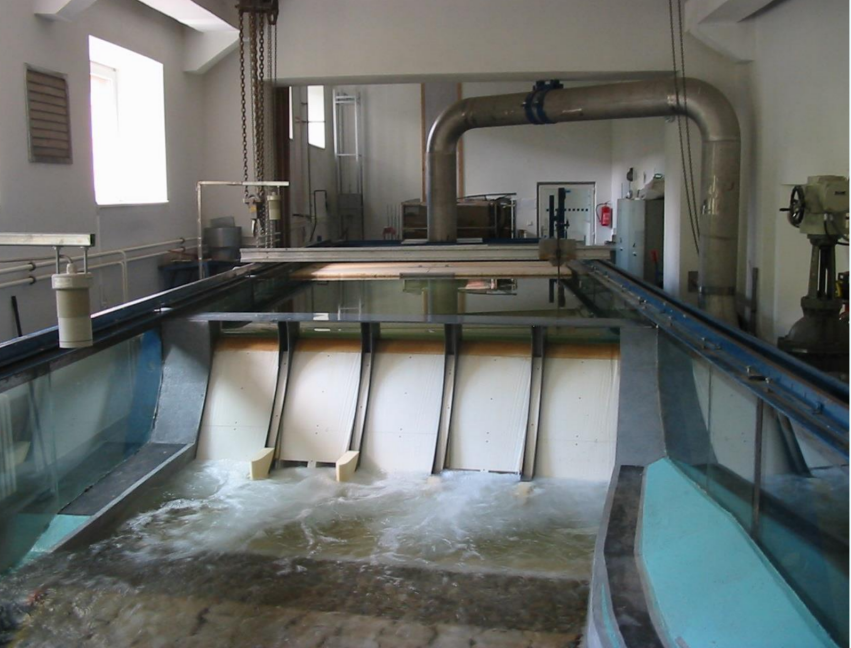
The Faculty of Civil Engineering (FCE) is one of the leading institutions in water management in the Czech Republic. Extensive research is carried out here in water management, water treatment, and landscape protection against drought and floods.
Examples include water retention in the landscape through strip cropping systems, and the design and implementation of a wastewater treatment plant using a vertical vegetated filter and an artificial wetland without electricity consumption, which received the Ecological Project of the Year 2024 award.
There is also collaboration with Brněnské vodárny a kanalizace on monitoring the quality of drinking and wastewater, as well as flood protection measures developed in cooperation with the Czech Academy of Sciences and the City of Brno.
Experts from the Faculty of Mechanical Engineering (FME) have developed a patented technology, CaviPlasma, which combines cavitation and low-temperature plasma and can further treat up to 15 m³ of water per hour, removing pharmaceuticals, pesticides, and estrogen residues from contraception. The technology has received the MSV Gold Medal, the main award of the Technology Agency of the Czech Republic, and was presented at EXPO 2025 in Japan.
The results of our research are applied directly in practice in municipalities and cities, also through spin-off companies such as ConWe — natural wastewater treatment systems for households and municipalities — and VODA BRNO, which developed the Astacus® robot for automated cleaning and monitoring of water pipelines.
Water Management
At the end of 2025, we prepared the Water Management Analysis at BUT. It provided a comprehensive overview of the current state of water management across faculties, identified savings potential, and proposed concrete measures for further development.
Partial reports for individual faculties were based on a combination of spatial data from BUT GIS — roof areas, paved surfaces, and green areas — and operational data: numbers of students and staff, types of sanitary equipment, and current water consumption. An important part of the process was direct cooperation with faculty representatives and building managers.
A number of measures are already in place at BUT: water-saving fixtures (aerators), efficient flushing systems, and rainwater retention tanks used for irrigation, slowing runoff, and flushing toilets.
What we do:
Development of Water-Saving SolutionsBased on the analysis results, we are gradually introducing additional water-saving measures and supporting the use of rainwater wherever it makes technical and economic sense.
Planning and Investment
Water management principles are integrated into new projects.
Monitoring
We are developing more precise monitoring of water consumption to quickly identify problems and leaks.
Engaging People
We inform students and staff about how they can contribute — every drop counts. We encourage seeing water as a valuable resource and reporting issues such as dripping taps or leaking toilets.